
WDHB Research
Learning by doing: rethinking how organizations learn
What cognitive science can teach L&D? An insight into our in-house PhD research project.

October 6, 2026
6 mins read
Our in-house researcher, Kübra Simsek, is working on her CIFRE PhD “Weaving Body and Mind: Toward Experiential and Embodied Organizational Learning”. It’s a specific French doctoral program where a company recruits a Master’s graduate to complete a 3-year research thesis in partnership with a public academic laboratory. Kübra is also working in thought leadership and solutions innovation for WDHB. In this article, she explains how her research fits into WDHB’s mission and strategy.
When I first explain my PhD to someone, it almost always sparks curiosity: “What does a professional training company funding research on the body and cognition actually look like in practice?” Cognitive science, with its precise vocabulary and rigorous protocols, and Learning & Development (L&D), a field that designs training programs for organizations every day, rarely speak to each other. That is precisely what WDHB wants to change.
For decades, WDHB has designed learning expeditions, immersive experiences in which executives step into other economic and cultural ecosystems to transform the way they think and act. Rather than relying solely on accumulated experience and pedagogical intuition, the company chose a less common path: funding a CIFRE PhD, hosting a doctoral researcher – me! – for three years to investigate, scientifically, what its programs actually produce in the people who experience them.
This remains unusual in L&D. The field produces countless programs, tools, methods, and promises, but much less scientific research designed to support and inform that work. Research takes time, patience, and a willingness to accept that a PhD does not deliver immediate results, unlike a program that can be sold the following quarter.
From intuition to evidence
WDHB’s approach is therefore not simply about finding new ideas to incorporate into its programs. By funding a CIFRE PhD, the company is investing in the theoretical foundations of human-centric learning.
This raises a question worth asking for anyone who designs learning programs: What does the format you repeat year after year actually rest on? Is it built on results that have been observed and documented, or on the feeling, often justified but rarely tested, that “it worked well last time”?
My research starts from a simple intuition. We still tend to think of learning as something that happens primarily in the head. We deliver content, a presentation, a module, and hope that people will remember it and apply it.
That approach is not unreasonable. It is simply incomplete.
For several decades, cognitive science has shown that human cognition is not just about the brain: it is embodied. It develops through the body, through lived experience, and through action itself (Agostini & Francesconi, 2021; Borghi & Cimatti, 2010).
What does embodied cognition actually study?
Embodied cognition is a broad research area that looks at how thinking and learning are shaped by the body and by our interactions with the environment. It asks questions such as: How does movement influence the way we perceive and remember something? How do physical sensations affect decision-making? What happens when we have to learn through action rather than observation?
These questions challenge the idea that cognition happens independently from the body. They suggest that perception, movement, emotion, environment, and action can all play a role in how we think and learn.
You understand a culture differently when you move through it, encounter it, and sometimes get things wrong. The same applies to skills such as negotiation. Some forms of learning only become meaningful when we are actually in the situation, feeling the tension rise, responding to someone we cannot fully predict, and adjusting our approach in real time.
My PhD asks what these principles mean at the organizational level. More specifically, to what extent can experiential learning and embodied cognition help us rethink organizational learning and professional training?
From individual cognition to organizational reality
My academic journey began with two undergraduate degrees pursued simultaneously, one in psychology and one in cognitive science, before I devoted myself entirely to cognitive science through my master’s degree. I became interested in how cognition develops through action, movement, and contact with the world. When I started this PhD, I felt as though I was not really changing disciplines, but changing the setting in which I was exploring the same question.
The question is no longer being asked at the level of an individual in a laboratory. It is being asked at the scale of an entire organization, with budget constraints, commercial deadlines, and real employees who have neither the time nor necessarily the desire to take part in a research study.
The question is no longer being asked at the level of an individual in a laboratory. It is being asked at the scale of an entire organization, with budget constraints, commercial deadlines, and real employees who have neither the time nor necessarily the desire to take part in a research study.
That shift in scale is precisely what marked my real entry into this PhD. Moving from the laboratory to the corporate world is not simply a matter of changing workplaces. It means learning to live between two worlds that do not operate at the same pace.
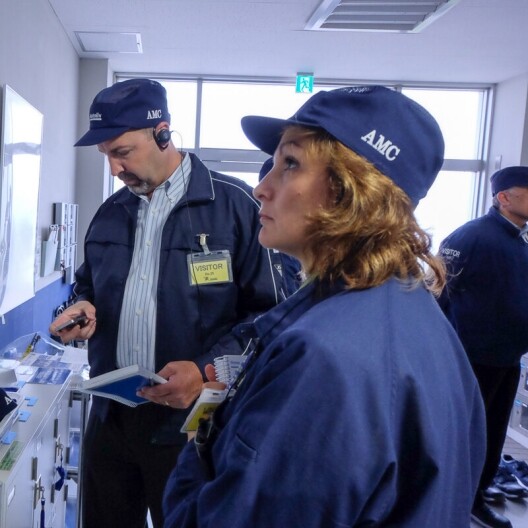
That tension became tangible during my first year, when I observed sales executives from a European multinational immersed in Chinese and Parisian ecosystems as part of an executive development program.
What fieldwork revealed
I watched them learn not through presentations, but by walking through stores, trying to understand unfamiliar business models, and confronting assumptions they did not realize they held.
Many arrived in China with an outdated image of Made in China. Many left surprised by how much the country, and their own perceptions, had changed.
“Coming back to China for the second time has been a much bigger wake-up call, because we have a lot to learn from them. And in just three years, they’ve progressed so much compared with us.”
What interested me most was not only what participants were learning, but how they were learning it. No slide about the evolution of the Chinese market could have produced the same experience as physically encountering it.
And I was not simply observing this process. I was experiencing it myself. The boundary between researcher and participant became blurred, forcing me to confront the same question at the heart of my research: what does lived experience contribute to learning that content alone cannot?
This is particularly important at the organizational level. An individual may learn something through an experience, but what happens when they return to their team? How does an experience become shared knowledge? How does something felt and understood individually become part of how an organization thinks and acts?
These are the questions I am now exploring more closely through the embodied cognition dimension of my research.
What gets lost when corporate learning accelerates?
This research also responds to a growing tension in organizational learning. Knowledge becomes obsolete faster, new tools appear constantly, and organizations are under pressure to learn and adapt more quickly.
At the same time, I sometimes wonder whether the world still has the patience to listen to what long-term research has to say. When artificial intelligence and new technologies promise immediate answers, spending three years investigating how people actually learn can feel almost counterintuitive.
But perhaps that is precisely why the research matters.
The faster the world moves, the more important it becomes to understand what, in human learning, cannot simply be accelerated.
What this could mean for learning design
The research is still ongoing, and I do not know what the final answer will be. The field may reveal situations in which embodied approaches add little compared with more traditional methods. That possibility is part of the scientific process.
For WDHB, the goal is not to turn every learning experience into a physical activity. It is to better understand when and why experience, action, environment, and the body can contribute to learning, and to use that knowledge to strengthen the design of Learning Expeditions.
Ultimately, this could mean questioning some very familiar L&D reflexes. Instead of beginning with a context-setting slide, for example, what if participants first encountered a situation they had to navigate themselves? Instead of explaining a concept before asking people to apply it, what if the experience came first and the explanation followed?
The point is not to make learning more entertaining. It is to understand more precisely how learning happens, and to design accordingly.
I am now at the beginning of my second year. Data collection is ongoing, and the conclusions are not yet known. But one thing has already become clear through my fieldwork: we still design professional learning as though learning happened primarily in the head, even though our bodies are constantly involved in how we perceive, act, adapt, and remember.
So here is the question I would like to leave you with:
In your own learning programs, where do the body and lived experience genuinely have a place, and where could they have a greater one?
If you are exploring this question in your own organization, I would be very happy to hear from you and discuss it.
Let's start a conversation!
Whether you have a specific need, are looking for a new partner, or simply curious about what we do, our team would love to hear from you.